The Shape of Dying: Why the Four Illness Trajectories Matter in Serious Illness Care
How recognizing patterns of decline helps clinicians anticipate needs, guide families, and plan hospice care
Introduction
By noon she was unconscious.
That morning her mother had eaten three small bites of oatmeal. Similar mornings had felt like proof she would recover. Until that day.
Her daughter stood at the bedside and said quietly, “No one told us it could happen this fast.”
Moments like this are common in serious illness. Families often experience decline as sudden, even when the underlying disease has been advancing for months or years.
To relieve suffering, clinicians must understand something about the future. We cannot predict the exact day someone will die. But we can often recognize the path illness is taking and prepare patients and families for what is likely ahead.
Physicians routinely overestimate survival. In one landmark study of terminally ill patients, clinicians overestimated prognosis by a factor of more than five (Christakis & Lamont, 2000). When prognosis is unclear or delayed, hospice referral often occurs late and families are left unprepared.
Yet death rarely unfolds randomly. In most serious illnesses, decline follows recognizable patterns.
Research in palliative care has shown that most patients experience one of four broad illness trajectories near the end of life:
Sudden Death
Terminal Illness
Organ Failure
Frailty
These patterns were described in population studies examining functional decline before death and have since become a foundational framework in palliative care education (Lunney et al., 2003; Murray et al., 2005).
Understanding these trajectories shifts the goal from prediction to preparation.
Two questions help anchor this thinking.
The Six-Month Question asks: Is this patient likely to have a life expectancy of six months or less if the illness runs its normal course? It guides assessment; Medicare hospice eligibility requires physician certification supported by the clinical record.
A second Surprise Question asks: Would you be surprised if this patient were still alive in twelve months? Used after a “no” to the original question, it may prompt earlier palliative planning and, when appropriate, hospice referral.
Trajectory recognition extends these questions further. It asks not only how long, but how decline is likely to unfold.
Recognizing the shape of illness allows the interdisciplinary team to anticipate symptoms, prepare families, and align care before crisis occurs.
Trajectory recognition is how we move from hospice eligibility to hospice strategy.
I. The Four Common Trajectories of Decline
Each broad category of slope carries its own pace and preparation. Imagine four lines on a graph—one drops like a cliff, one plunges after a long plateau, one dips and rises in jagged waves, and one slopes so gently at times you almost miss it.
Visual Reference: The Four Trajectories of Functional Decline
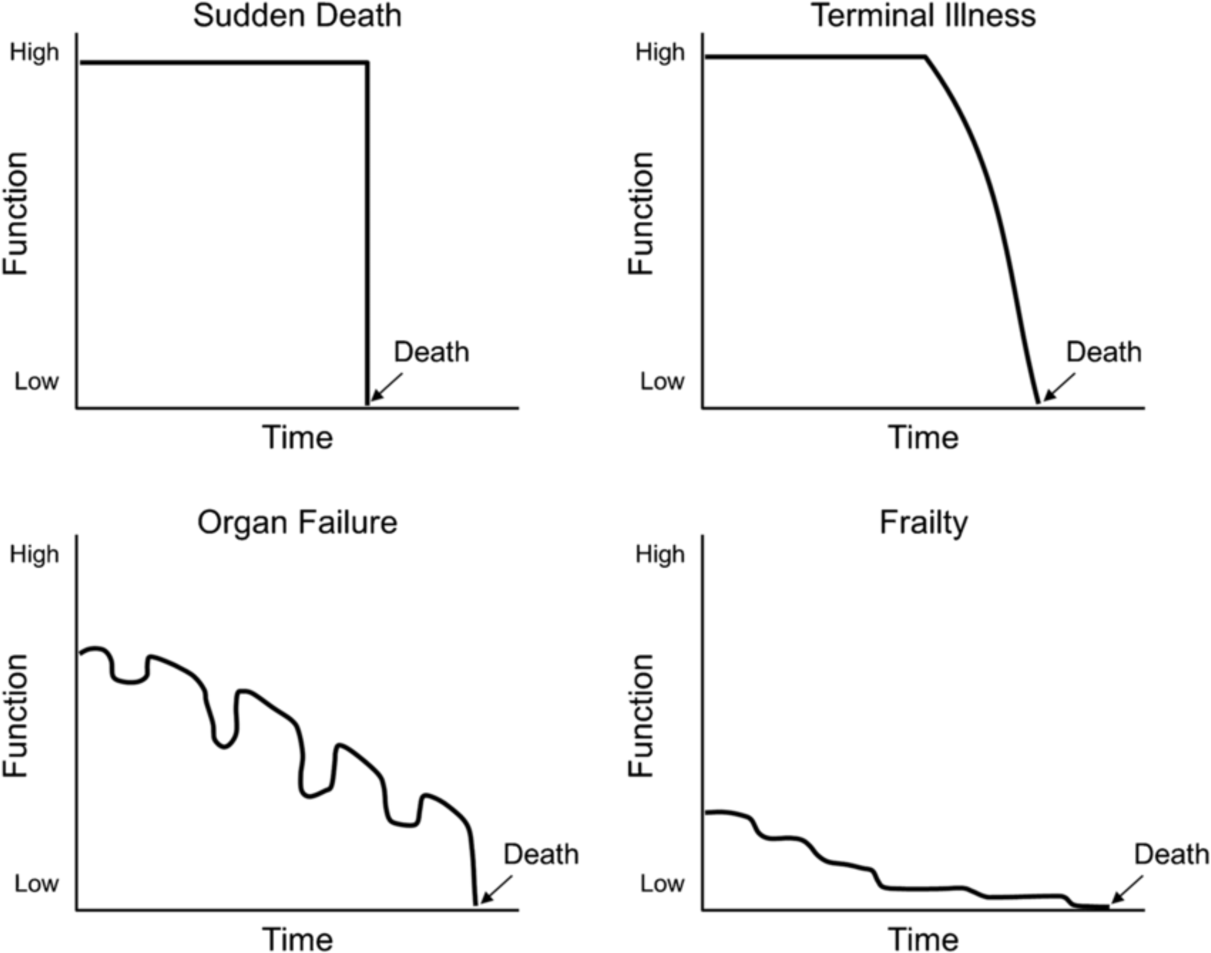
Source: Lunney JR, Lynn J, Foley DJ, Lipson S, Guralnik JM. Patterns of functional decline at the end of life. JAMA. 2003;289(18):2387–2392. doi:10.1001/jama.289.18.2387
This model helps you recognize patterns early. Published in JAMA in 2003, it not only introduced this now-familiar above visual but confirmed clinical relevance with more than 4,000 patients. The study remains a grounded source for hospice trajectory education.
Sudden Death – High function until abrupt end; often precedes hospice referral.
Terminal Illness – Stable function with steep decline.
Organ Failure – Repeated crises, incomplete recoveries.
Frailty/Dementia – Long, slow decline until a minor event causes collapse.
II. Prognostication: A Skill Worth Pursuing
Empty section
Why Prognostication Matters
Families don’t need certainty. They need orientation.
Tools for Better Forecasting
Performance status and change over time can inform prognosis. The Palliative Performance Scale (PPS) summarizes ambulation, activity, self-care, intake, and level of consciousness. It supports, but does not replace, clinical judgment.
Naming the trajectory aligns care with reality. It informs—not replaces—clinical judgment.
III. The Interdisciplinary Group’s (IDG) Role in Trajectory Recognition
Empty section
When the Team Misses the Pattern
When the Interdisciplinary Group (IDG), the team of nurses, social workers, aides, and chaplains, fails to name the trajectory:
The nurse under-forecasts decline.
The social worker misses anticipatory grief cues.
The aide’s instincts are ignored.
The chaplain senses withdrawal but can’t explain it.
The family is unprepared.
Common Pitfalls
Over reliance on labs
Making inferences with limited information
Hesitating to name a trajectory due to fear of being wrong, thereby delaying preparation.
Underestimating the observations of experienced staff
When the Team Names It Clearly
Expectations align.
Medications make contextual sense.
The team plans for what’s coming—not just what is. A seasoned social worker said: “When families think they have months and we know it’s days, their grief gets ambushed.” No single discipline owns trajectory recognition. It’s a shared clinical mosaic, and as a new physician, you’ll rely on your IDG to refine this skill.
IV. Turning Recognition into Action
How to act on a trajectory as a new hospice physician:
Document it: "Organ failure trajectory, likely more and worse heart failure flare-ups."
Say aloud: "This pattern may repeat—with poorer recovery." Example: You notice a COPD patient’s recent hospitalization signals an Organ Failure trajectory. Document this in the chart and propose a comfort kit at the next IDG to prepare for worsening crises. This informs your team and the family, building confidence in your clinical decisions.
First Steps checklist:
Assess present and historical function with patient, family, and via the clinical records.
Ask IDG about recent trajectory shifts during reviews.
Practice the family forecast script in team discussions
Care Plan and frequently reassess
V. Mapping Trajectories: From Pattern to Practice
Note: Some patients shift trajectories after new injuries, infections, or weight loss. For example, a COPD patient may follow a frailty-like course after an aspiration event. IDGs should re-map trajectories after major clinical changes.
Steps for Teams
Tip for IDG Chairs: Use a 2-minute teach-in to normalize trajectory talk. “Let’s name the likely trajectory—then check if our care plan matches it.” Caution: Trajectory slope doesn’t dictate visit frequency, but steeper declines may require rapid plan revisions or urgent physician follow-up.
During IDG Review
Identify the primary trajectory.
Note changes in slope, crises, or recoveries.
As a Documentation Anchor
In notes or visits: “Continues on a frailty trajectory with PPS of 40%, minimal reserves. Now a 2-person assist to chair in the last 2 weeks.”
Steps for Families
Teach the Pattern
Example: “Here’s the pattern we often see in dementia.”
Two-Week Forecast: “She seems steady, but these small changes are expected to continue without improvement.”
Sample Family Forecast Script
Explain: “Your loved one may have good and bad days.”
Prepare: “Over time, bad days may increase, and recovery may be harder.”
Reassure: “We’ll stay close and offer help for shortness of breath, like a comfort kit, if needed.”
Respect Family Beliefs
Ask: “How do you talk about serious illness in your family?”
Adjust: “We’re planning for comfort as her body slows,” to respect cultural norms.
Closing Reflection
Patients do not decline in straight lines. But when you recognize the shape of likely decline, you can ready the road ahead. You can’t stop what’s coming, but you can guide patients and families through it.
Don’t try to predict death’s arrival. Just name the shape it takes and give guidance. That’s your work now, and your IDG team will help you refine it.
- Unexpected hospice deaths often reflect failures to recognize or communicate the trajectory, not random clinical events.
- Recognizing trajectory patterns helps teams plan, forecast, and communicate more effectively.
- Preparation reshapes grief: when families know what is possible, they experience less shock.
- Use the Two-Minute Forecast in IDG to normalize uncertainty and reduce panic.
- Name each patient’s illness trajectory in IDG to guide visit strategy and family education.
“Which illness trajectory best fits this patient, and what should the team prepare for next?”
- Centers for Medicare & Medicaid Services. 42 CFR §418.22, Certification of terminal illness. https://www.ecfr.gov/current/title-42/chapter-IV/subchapter-B/part-418/subpart-B/section-418.22
- Christakis NA, Lamont EB. Extent and determinants of error in doctors’ prognoses in terminally ill patients: prospective cohort study. BMJ. 2000;320(7233):469–473. doi:10.1136/bmj.320.7233.469
- Ermers DJ, Kuip EJ, Veldhoven CMM, et al. Timely identification of patients in need of palliative care using the Double Surprise Question: a prospective study on outpatients with cancer. Palliative Medicine. 2021;35(3):592–602. doi:10.1177/0269216320986720
- Jang RW, Caraiscos VB, Swami N, et al. Simple prognostic model for patients with advanced cancer based on performance status. Journal of Oncology Practice. 2014;10(5):e335–e341. doi:10.1200/JOP.2014.001457
- Lunney JR, Lynn J, Foley DJ, Lipson S, Guralnik JM. Patterns of functional decline at the end of life. JAMA. 2003;289(18):2387–2392. doi:10.1001/jama.289.18.2387
- Murray SA, Kendall M, Boyd K, Sheikh A. Illness trajectories and palliative care. BMJ. 2005;330(7498):1007–1011. doi:10.1136/bmj.330.7498.1007
- Victoria Hospice. Palliative Performance Scale version 2 (PPSv2). https://victoriahospice.org/wp-content/uploads/2019/12/PPSv2-English-Sample.pdf
Brian H. Black, D.O., FAAFP, HMDC, is a hospice physician-educator, family physician, and editor of Hospice Synopsis. His work focuses on making hospice care clearer, more clinically useful, and more human. Through Hospice Synopsis, Dr. Black translates clinical evidence, bedside experience, and the complexities of end-of-life care into practical guidance for clinicians, patients, families, and communities.
Discussion · 0
- 01Introduction
- 02I. The Four Common Trajectories of Decline
- 03II. Prognostication: A Skill Worth Pursuing
- 04Why Prognostication Matters
- 05Tools for Better Forecasting
- 06III. The Interdisciplinary Group’s (IDG) Role in Trajectory Recognition
- 07When the Team Misses the Pattern
- 08Common Pitfalls
- 09When the Team Names It Clearly
- 10IV. Turning Recognition into Action
- 11V. Mapping Trajectories: From Pattern to Practice
- 12Steps for Teams
- 13Steps for Families
- 14Closing Reflection
- 153-2-1 Summary
- 16Bibliography